IMDb >
Bronenosets Potyomkin (1925)
Quicklinks
Top Links
trailers and videosfull cast and crewtriviaofficial sitesmemorable quotesOverview
main detailscombined detailsfull cast and crewcompany creditstv scheduleAwards & Reviews
user commentsexternal reviewsnewsgroup reviewsawardsuser ratingsparents guiderecommendationsmessage boardPlot & Quotes
plot summarysynopsisplot keywordsAmazon.com summarymemorable quotesFun Stuff
triviagoofssoundtrack listingcrazy creditsalternate versionsmovie connectionsFAQOther Info
merchandising linksbox office/businessrelease datesfilming locationstechnical specslaserdisc detailsDVD detailsliterature listingsNewsDeskPromotional
taglines trailers and videos posters photo galleryExternal Links
showtimesofficial sitesmiscellaneousphotographssound clipsvideo clipsBronenosets Potyomkin (1925) More at IMDbPro »
| Photos (see all 33 | slideshow) |
Overview
User Rating:
Director:
Writer:
Release Date:
12 November 1926 (France)
more
Plot:
A dramatized account of a great Russian naval mutiny and a resulting street demonstration which brought on a police massacre. full summary | full synopsis
Plot Keywords:
Sailor
|
Battleship
|
Meat
|
Revolution
|
Steps
more
NewsDesk:
(12 articles)
The Imaginarium of Doctor Gilliam
(From Huffington Post. 20 December 2009, 5:23 PM, PST)
Inglourious Basterds (Blu-Ray/DVD Review)
(From Fangoria. 17 December 2009, 1:10 AM, PST)
(From Huffington Post. 20 December 2009, 5:23 PM, PST)
Inglourious Basterds (Blu-Ray/DVD Review)
(From Fangoria. 17 December 2009, 1:10 AM, PST)
User Comments:
One of the greatest movies ever made.
more (125 total)
Cast
(Credited cast)| Aleksandr Antonov | ... | Grigory Vakulinchuk - Bolshevik Sailor | |
| Vladimir Barsky | ... | Commander Golikov | |
| Grigori Aleksandrov | ... | Chief Officer Giliarovsky | |
| Ivan Bobrov | ... | Young Sailor Flogged While Sleeping (as I. Bobrov) | |
| Mikhail Gomorov | ... | Militant Sailor | |
| Aleksandr Levshin | ... | Petty Officer | |
| N. Poltavtseva | ... | Woman With Pince-nez | |
| Konstantin Feldman | ... | Student Agitator | |
| Prokopenko | ... | Mother Carrying Wounded Boy | |
| A. Glauberman | ... | Wounded Boy | |
| Beatrice Vitoldi | ... | Woman With Baby Carriage | |
| rest of cast listed alphabetically: | |||
| Brodsky | ... | Student | |
| Julia Eisenstein | ... | Woman with Food for Sailors | |
| Sergei M. Eisenstein | ... | Odessa Citizen | |
| Andrei Fajt | ... | Recruit (as A. Fait) | |
| Korobei | ... | Legless Veteran | |
| Marusov | ... | Officer | |
| Protopopov | ... | Old Man | |
| Repnikova | ... | Woman on the Steps | |
| Vladimir Uralsky | |||
| Zerenin | ... | Student | |
Additional Details
Also Known As:
Battleship Potemkin (UK) (USA)
Броненосец Потёмкин (Soviet Union: Russian title)
Bronomzidi Potiomkini (Soviet Union: Georgian title)
Potemkin (USA)
The Armored Cruiser Potemkin (USA)
The Battleship Potemkin (USA)
The Battleship Potyomkin (USA) (alternative transliteration)
more
Броненосец Потёмкин (Soviet Union: Russian title)
Bronomzidi Potiomkini (Soviet Union: Georgian title)
Potemkin (USA)
The Armored Cruiser Potemkin (USA)
The Battleship Potemkin (USA)
The Battleship Potyomkin (USA) (alternative transliteration)
more
Parents Guide:
Runtime:
75 min | Spain:70 min | Spain:77 min | USA:66 min | Argentina:80 min | Russia:71 min (DVD version) | Spain:68 min (DVD edition)
Country:
Language:
Colour:
Aspect Ratio:
1.33 : 1 more
Sound Mix:
Certification:
Italy:(Banned) (1925 - 1960) |
Italy:T (1960) |
Canada:G (Ontario) |
USA:TV-G (TV rating) |
South Korea:15 (1994) |
Argentina:Atp |
Chile:TE |
Finland:(Banned) (1930) |
Finland:K-12 (1978) |
Finland:K-16 (1952) |
Germany:(Banned) (1933-1945) |
Germany:12 |
Netherlands:AL (video rating) |
Norway:16 (original rating) |
Portugal:17 (original rating) |
Portugal:M/12 (DVD rating) |
Portugal:M/16 (re-rating) (1974) |
Spain:T |
Sweden:15 |
UK:PG (re-rating) (1987) |
UK:X (original rating) |
USA:Unrated
Filming Locations:
Fun Stuff
Trivia:
Battleship "Dvenadtsat Apostolov" actually was in the Imperial squadron, sent against "Potemkin". "Potemkin" itself was newest and most powerful of Black Sea battleships, but Imperial forces were more numerous.
more
Goofs:
Revealing mistakes: Vakulinchuk is breathing slightly as his body lies in state.
more
Movie Connections:
Featured in "Cinemania: Oi apagorevmenes tainies: I logokrisia ston kinimatografo" (2009)
more
FAQ
This FAQ is empty. Add the first question.more (125 total)
Message Boards
Discuss this movie with other users on IMDb message board for Bronenosets Potyomkin (1925) moreRecommendations
If you enjoyed this title, our database also recommends:
Show more recommendations
|
|
|
|
|
| Our Fighting Navy | Die Blechtrommel | Salvatore Giuliano | Children of the Revolution | Bloody Sunday |
|
IMDb User Rating:
|
IMDb User Rating:
|
IMDb User Rating:
|
IMDb User Rating:
|
IMDb User Rating:
|
Related Links
| Full cast and crew | Company credits | External reviews |
| News articles | IMDb Drama section | IMDb Soviet Union section |
| Add this title to MyMovies |


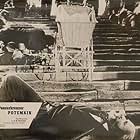
Originally supposed to be just a part of a huge epic The Year 1905 depicting the Revolution of 1905, Potemkin is the story of the mutiny of the crew of the Potemkin in Odessa harbor. The film opens with the crew protesting maggoty meat and the captain ordering the execution of the dissidents. An uprising takes place during which the revolutionary leader is killed. This crewman is taken to the shore to lie in state. When the townspeople gather on a huge flight of steps overlooking the harbor, czarist troops appear and march down the steps breaking up the crowd. A naval squadron is sent to retake the Potemkin but at the moment when the ships come into range, their crews allow the mutineers to pass through. Eisenstein's non-historically accurate ending is open-ended thus indicating that this was the seed of the later Bolshevik revolution that would bloom in Russia. The film is broken into five parts: Men and Maggots, Drama on the Quarterdeck, An Appeal from the Dead, The Odessa Steps, and Meeting the Squadron.
Eisenstein was a revolutionary artist, but at the genius level. Not wanting to make a historical drama, Eisenstein used visual texture to give the film a newsreel-look so that the viewer feels he is eavesdropping on a thrilling and politically revolutionary story. This technique is used by Pontecorvo's The Battle of Algiers.
Unlike Pontecorvo, Eisenstein relied on typage, or the casting of non-professionals who had striking physical appearances. The extraordinary faces of the cast are what one remembers from Potemkin. This technique is later used by Frank Capra in Mr. Deeds Goes to Town and Meet John Doe. But in Potemkin, no one individual is cast as a hero or heroine. The story is told through a series of scenes that are combined in a special effect known as montage--the editing and selection of short segments to produce a desired effect on the viewer. D.W. Griffith also used the montage, but no one mastered it so well as Eisenstein.
The artistic filming of the crew sleeping in their hammocks is complemented by the graceful swinging of tables suspended from chains in the galley. In contrast the confrontation between the crew and their officers is charged with electricity and the clenched fists of the masses demonstrate their rage with injustice.
Eisenstein introduced the technique of showing an action and repeating it again but from a slightly different angle to demonstrate intensity. The breaking of a plate bearing the words "Give Us This Day Our Daily Bread" signifies the beginning of the end. This technique is used in Last Year at Marienbad. Also, when the ship's surgeon is tossed over the side, his pince-nez dangles from the rigging. It was these glasses that the officer used to inspect and pass the maggot-infested meat. This sequence ties the punishment to the corruption of the czarist-era.
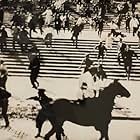
The most noted sequence in the film, and perhaps in all of film history, is The Odessa Steps. The broad expanse of the steps are filled with hundreds of extras. Rapid and dramatic violence is always suggested and not explicit yet the visual images of the deaths of a few will last in the minds of the viewer forever.
The angular shots of marching boots and legs descending the steps are cleverly accentuated with long menacing shadows from a sun at the top of the steps. The pace of the sequence is deliberately varied between the marching soldiers and a few civilians who summon up courage to beg them to stop. A close up of a woman's face frozen in horror after being struck by a soldier's sword is the direct antecedent of the bank teller in Bonnie in Clyde and gives a lasting impression of the horror of the czarist regime.
The death of a young mother leads to a baby carriage careening down the steps in a sequence that has been copied by Hitchcock in Foreign Correspondent, by Terry Gilliam in Brazil, and Brian DePalma in The Untouchables. This sequence is shown repeatedly from various angles thus drawing out what probably was only a five second event.
Potemkin is a film that immortalizes the revolutionary spirit, celebrates it for those already committed, and propagandizes it for the unconverted. It seethes of fire and roars with the senseless injustices of the decadent czarist regime. Its greatest impact has been on film students who have borrowed and only slightly improved on techniques invented in Russia several generations ago.